Many people accept bees as honey-giving and sometimes biting insects :). We usually do not associate bees with other products or properties. However, their importance, like that of other insects, is much deeper and their role in nature is very important. Some farmers know how important bees are in increasing productivity. The following story describes some aspects of a pleasant and mutually beneficial neighborhood between bees and farmers.
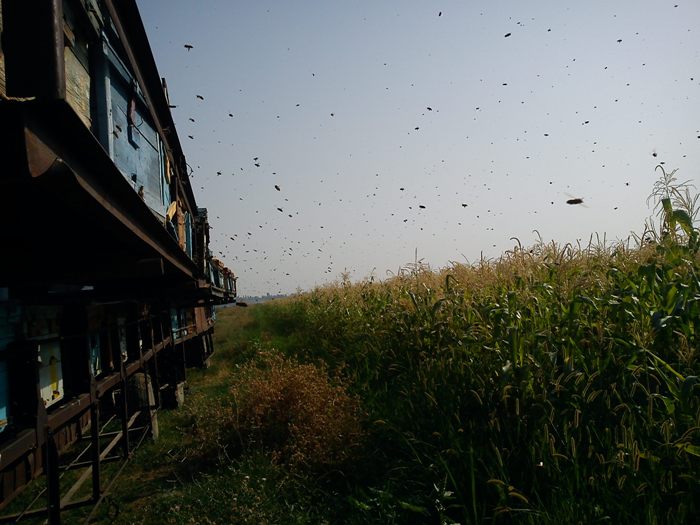
Bees should be seen by farmers as a necessary attribute to increase the productivity of their crops. Although the goal of our project is local - to help local beekeeping in the Parkent district of Tashkent region, we also wanted to involve farmers in the development of beekeeping. The reason is simple - if there are bees near the planted area, the yield will be higher than if there are no bees nearby. In many countries, farmers pay beekeepers to build nests near their fields.
The process is simple: without pollination, the crop cannot be formed. There are two types of crops - they undergo self-pollination (wheat, peas, potatoes, etc.) and require cross-pollination (cotton, clover, sunflower, etc.). Cross-pollination can be artificial, wind or, most effectively, insects. In other words, insect pollination is an important environmental process for most oilseeds, fodder, and industrial crops. Pollination of fruits (apricots, apples, pears, cherries, cherries, plums, peaches), berries, vegetable crops (cucumbers, onions, cabbage, turnips, radishes, etc.), as well as in increasing the yield of indoor crops very important. plants.
Take cotton, for example:
"Cotton pollen is heavy and sticky, so wind pollen is not possible. Pollen is transferred from one plant to another by insects, mainly bumblebees and bees. Possible grains at a distance of up to 4 km" 1.
As a result of bee pollination of cotton, the yield (10-24%) and quality of raw cotton significantly increase. The increase in productivity is also observed in the first and second generation generations.
In addition to increasing productivity, the production of direct beekeeping products - honey - is also important for the economy. Depending on the level of irrigation and cotton navigation, from 1 hectare of cotton can be obtained from 1 hive to 0.5 kg to 3.5 kg of honey per day. On average, 1-2 families of bees (hives) are needed for complete pollination on 1 hectare. In fact, 20 12-frame beehives, each adjacent to a 10-hectare cotton field, provide 700 to 3,000 kg of pure cotton honey to beekeepers from late July to the flowering period of September. AN-Boyavut-2 is the most productive cotton variety in Uzbekistan.
"Experience shows that with good agricultural technology, effective pollination of flowers by bees can significantly increase the yield of agricultural crops. For example, 50-60% more sunflower, rapeseed and mustard than fruit plantations - 45 -50%, buckwheat - 50-55%, esfort, alfalfa, alfalfa, fic - 35-40%, melons - 100-150% when flowers are pollinated by bees, the yield of vegetable seeds (cabbage, onions, carrots). It is important that the quality of fruits and seeds is significantly improved by good pollination of flowers by bees "...
Pollination of bees should be incorporated into the technology of growing flower crops everywhere, and the labor of beekeepers engaged in pollinating bees should be paid extra depending on the quality of work and the yield of pollinated crops, for example in the United States. , where the beekeeper pays $ 50 for each hive used for pollination.a acre (= 0.405 ha). “Kashkovskiy V.G. Bees and crops ”(VG Kashkovskiy, ND Mashinskaya - Novosibirsk 2005 - 111 p.)
It is the bees that are the insects that perform the necessary ecological function in the agricultural landscape. Wild pollinating insects, unfortunately, do not have optimal conditions for living in a man-altered landscape. Human treatment of crops (drugs and / or chemicals, such as urea or defoliation) is harmful to wild insects and bees. However, the presence of bees can be controlled during processing, which helps prevent unnecessary insect death. The farmer must, of course, be notified in advance of the start of field cultivation.
In our project, we compared how alfalfa and cucumber yields change depending on the presence of bees. Irrigation conditions are the same b the same dead fields were selected, but no bee pollination was observed in the control fields, and 10 beehives with 12 frames were installed in each hive near the exhibition area.
To show the increase in alfalfa yields, the alfalfa variety Tashkent-1, which is predominant in Parkent region, was used. The results are presented in Table 1.
Table No. 1. Comparison of clover yield depending on the presence of bees
| Clover pollinated by bees | Clover is not pollinated by bees |
Seedquality | Large, heavyfull | Veryloose, light |
Seeds for hectare (kg) | 57 kg | 37,3 kg |
Income from the sale of clover seeds for 20,000 soums for 1 kg. | 1 140 000 soums | 746 000 soums |
Total additional income for the farmer | 394 000 soums | 0 |
Honey production (when all the necessary agro-technical measures for alfalfa are carried out), 2 kg per hectare per day, the beekeeper stood 10 days. | 20 kg | 0 |
The income of a beekeeper from the sale of honey is 20,000 soumsfor1 kg. | 400 000 soums | 0 |
Additional income to the district economy from 1 hectare | 794 000 soums | 0 |
A similar demonstration was held for the cucumber harvest. All data are shown in Table 2.
Table 2. Comparison of cucumber yield depending on the presence of bees
| Clover pollinated by bees | Clover is not pollinated by bees |
Cucumberquality | Sweetjuicy | Sweetandsour |
Cucumber yield per 1 hectare (kg) | 2 600 kg | 2 000 kg |
Income from the sale of cucumbers from 200 soums for 1 kg. | 520 000soums | 400 000 soums |
Total additional income for the farmer (bees only stay 3 days) | 120 000 soums | 0 |
Honey production (in the implementation of all necessary agro-technical measures for cucumbers) | 300 grams in 3 days for one nest | 0 |
The income of a beekeeper from the sale of honey is 80,000 soumsfor 1 kg. | 48 000 soums | 0 |
Additional income to the district economy from 1 hectare | 168 000soums | 0 |
Conclusions and recommendations
The conclusion is simple and self-evident:
• The presence of bees near agricultural fields is beneficial to farmers in any case;
• Increased productivity as a result of pollination by bees from 10% to 100%, depending on the culture and growing conditions;
• Local authorities should fully support the work of beekeepers, as beekeepers need not only direct production of honey and other beekeeping products, which are important for the health of the population, but also farmers who produce additional crops. serving.
National Center for Biotechnology of Kazakhstan - http://gmobase-ncb.kz/ishodnye_organizmy/hlopchatnik/


